i didnt use clips from richards interviews in the end as i felt they didnt fit in with the rest of the sounds and were a bit random. I think the idea of making the audio sound like it was going around your head in a circle didnt come out very well it just seemed to be playing loud from one side then back to the other . if i was to do it again id use two microphones and move the objects i was using to make sound around the microphones rather than changing the audio in adobe audition to play out of the left or right ear as it would give a more convincing effect.
reaserch into 3d audio 3D audio effects are a group of sound effects that manipulate the sound produced by stereo speakers, surround-sound speakers, speaker-arrays, or headphones. This frequently involves the virtual placement of sound sources anywhere in three-dimensional space, including behind, above or below the listener. Some 3D technologies also convert binaural recordings to stereo recordings. MorrowSoundTrue3D converts binaural, stereo, 5.1 and other formats to 8.1 single and multiple zone 3D sound experiences in realtime.
i thought it i changed what ear the sound was coming out of and how loud it is it would make it seem like the music is playing round in a circle, ie if somthing was on your left it would sound louder in the left .
In the nature of things:
Art about mobility, lightness and freedom.
Simple creative acts of walking and marking
about place, locality, time, distance and measurement.
Works using raw materials and my human scale
in the reality of landscapes.
The music of stones, paths of shared footmarks,
sleeping by the river's roar.
Quote from richards website
Richard long is a english artist who is most know for his work with land art.
land art is when a piece of art is inextricably linked to the earth. It is also anart form that is created in nature, using natural materials such as soil, rock (bed rock, boulders, stones), organic media (logs, branches, leaves), and water with introduced materials such as concrete, metal, asphalt, or mineral pigments. Sculptures are not placed in the landscape, rather, the landscape is the means of their creation.
Nature has always been a subject of art, from the first cave paintings to twentieth-century landscape photography. I wanted to use the landscape as an artist in new ways. First I started making work outside using natural materials like grass and water, and this led to the idea of making a sculpture by walking. This was a straight line in a grass field, which was also my own path, going 'nowhere'. In the subsequent early map works, recording very simple but precise walks on Exmoor and Dartmoor, my intention was to make a new art which was also a new way of walking: walking as art. Each walk followed my own unique, formal route, for an original reason, which was different from other categories of walking, like travelling. Each walk, though not by definition conceptual, realised a particular idea. Thus walking – as art – provided a simple way for me to explore relationships between time, distance, geography and measurement. These walks are recorded in my work in the most appropriate way for each different idea: a photograph, a map, or a text work. All these forms feed the imagination.
—Richard Long
I think circles have belonged in some way or other to all people at all times. They are universal and timeless, like the image of a human hand. For me, that is part of their emotional power, although there is nothing symbolic or mystical in my work
I like the fact that every stone is different, one from another, in the same way all fingerprints, or snowflakes (or places) are unique, so no two circles can be alike. In the landscape works, the stones are of the place and remain there. With an indoor sculpture there is a different working rationale.
I want to use sound of what it would be like for someone walking in circles on a mountain to replicate what richard would have experienced ,
I have recored sounds of
someone walking
gravel falling
wind
rain
birds
rivers / streams
clothes russeling
breathing
and i have got sound bits from richards interviews and japanese musical instruments. which i will play on a loop and use a 3d audio technique to make it circular as i felt this was one of the key things he kept saying in interviews .
idea 1 - relating music
The image reminded me of an album cover you see on relaxing music albums so i could create something like this http://www.youtube.com/watch?v=iUAF0rVqGg4
as the mountain is in japan i could use Japanese musical instruments in the back ground.
idea 2 - mountain sounds
I could record someones journey to the top of a mountain so the sounds of them walking on gravel , stones falling off , birds etc
as circles are an important part of his work i would make the sound 3d as if its going round in a circle
idea 3 - richards journey to the top of the mountain
i could record the speach of what richard would have been thinking when walking up to the top of the mountain but then edit them in a pogo style to make it more interesting
i would use natural sounds and like sounds of someone walking up a mountain in the back ground then some kind of baking music like japanese instruments.
Simple creative acts of walking and marking about place, locality, time, distance and measurement. The music of stones, paths of shared footmarks,sleeping by the river's roar. ( quote from richards website )
The work involved placing small rocks from the surrounding area into a straight line of roughly uniform width that stretched for several metres in length. However, Long has explained that he had originally intended to create a different work, indicating how working directly in a landscape can be affected by conditions that are out of the artist’s control:The sculpture A Line in Japan (1979) came about because my original idea had been to make a map work recording a circular walk around Mt Fuji, following the snow line. However, as there was no snow on the mountain at all when I arrived, I had to follow a different idea.
I come to some mountains and I move some stones around and then I disappear. The mountains are changed, some stones are in a different place. But who has moved them and how it looks, that is not the important part. The only important thing is that the stones have been moved. They are visible but invisible as art.
This is another piece of work by richard along the same lines as this image
Pogo is an experimental electronic artist who cuts up audio clips from films and remixes them together to make new music. I thought this was interesting way to make music and could be useful in my project .
chiptune is music made from video games consoles. I like this music is i think they way it is created is interesting .
It is made by downloading a program to get the audio files from the games console and editing sections to make new music. See video below for more information
I like how audio can be used to create 3d sound effects.
They do this by placing 3 microphones 1 in the middle and 2 where your ears would be to make it sound the the audio is moving around your head.
I like this as it allows you to imaging what the scene might look like and position things in your head. http://en.wikipedia.org/wiki/3D_audio_effect
Types of microphone condenser - Condenser microphones require power from a battery or external source. The resulting audio signal is stronger signal than that from a dynamic.Condensers also tend to be more sensitive and responsive than dynamics, making them well-suited to capturing subtle nuances in a sound.
dynamic - Dynamic microphones are versatile and ideal for general-purpose use. They use a simple design with few moving parts. They are relatively sturdy and resilient to rough handling. They are also better suited to handling high volume levels, such as from certain musical instruments or amplifiers. They have no internal amplifier and do not require batteries or external power.
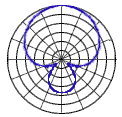
Hypercardioid
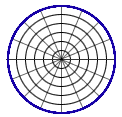
omni directional - Captures sound equally from all directions.
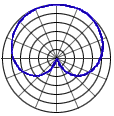
cardioid - Cardioid means "heart-shaped", which is the type of pick-up pattern these mics use. Sound is picked up mostly from the front, but to a lesser extent the sides as well.
This is exaggerated version of the cardioid pattern. It is very directional and eliminates most sound from the sides and rear. Due to the long thin design of hypercardioids, they are often referred to as shotgun microphones.